




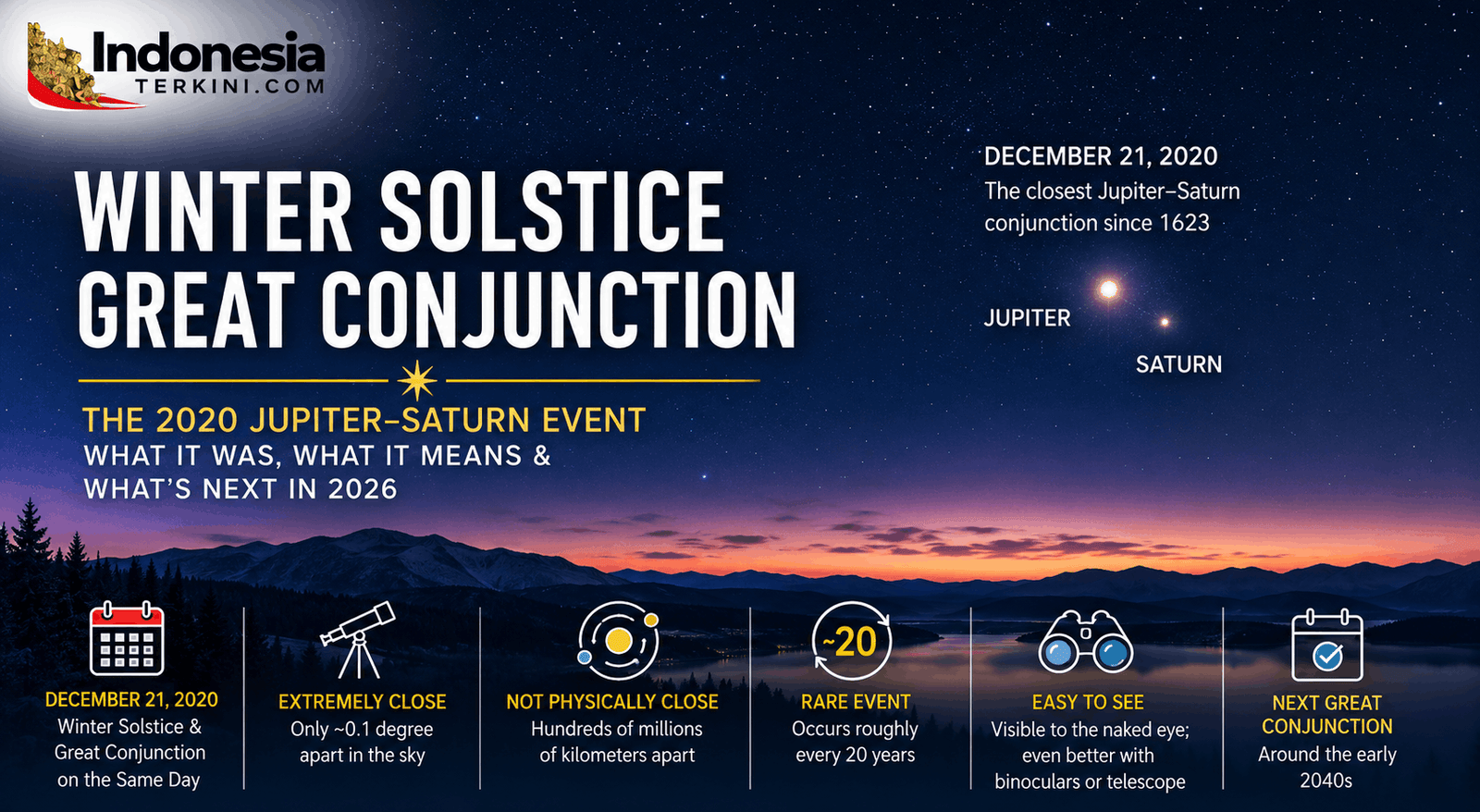
Great Conjunction of the Sun and Jupiter in the constellation Capricornus is one of the most memorable astronomical events of the 21st century. The conjunction of Jupiter and Saturn was a really close one at the end of 2020, on December 21st, in the evening sky, on the winter solstice in the Northern Hemisphere. It is known as “Great Conjunction” and also referred to as “Christmas Star”. Winter Solstice Great Conjunction
Great Conjunction of Winter Solstice has been compared with other events and is important to differentiate between 2020 and 2026 skywatching happenings. NASA’s 2026 astronomy calendar includes a Jupiter-Venus conjunction in June, a total solar eclipse in August and the Jupiter-Saturn conjunction in December – that is, the Great Conjunction for 2026, except for the new Jupiter-Saturn conjunction on the December 2026 solstice.
Key Takeaways
- The Great Conjunction of planets of the year took place on December 21st, 2020.
- It was the conjunction of Jupiter and Saturn as they seemed to be very close to each other from our point of view.
- It wasn’t that the planets were really near each other, but they were still hundreds of millions of kilometers apart.
- The separation for the 2020 event, which was very close, was about 0.1 degrees.
- Great Conjunction events of Jupiter and Saturn happen every about 20 years!
- There is no other Jupiter-Saturn Great Conjunction for the 2026 winter solstice.
- Other conjunctions of planets as well as significant skywatching events continue to be a feature of the current astronomy news.
What Is the Winter Solstice Great Conjunction?
Great Conjunction refers to the conjunction between Jupiter and Saturn as seen on earth. Neither planet ever collidesides nor does one ever approach another. Instead, they are all situated on orbit so that it looks like they are near one another from Earth’s perspective.
Jupiter takes approximately 12 years to orbit around the sun while Saturn takes around 30 years. Jupiter orbits the sun quicker than Saturn, so it overtakes them every 12 years or so. It is a Great Conjunction every 20 years or so.
WhatBY WHAT NAME DOES JUPITER AND SATURN’S CONJUNCTIONS GO ONLY AS GREAT. The two planets are the largest in the Solar system and so the conjunctions are called “great”.
Why Was the 2020 Great Conjunction So Special?
Of course, the most significant thing about the December 21, 2020 conjunction of Jupiter and Saturn was their closeness – closer than they have been seen in centuries.
NASA said it was a Jupiter-Saturn conjunction, but the planets would move about 10 times closer during this conjunction than during many normal conjunctions that occur between the planets. It was a day for the December solstice.
The two planets were closest together about 0.1 degree apart in the sky. According to sources in astronomy, the conjunction of 2020 is the closest Jupiter/Saturn conjunction since 1623 – and the closest conjunction at night was centuries earlier.
As seen by a spectator, these two celestial bodies looked like a single large star. Nevertheless, they could also be identified through binoculars or a telescope and some of their moons might also be visible.
How Does the Winter Solstice Connect to the Conjunction?
The winner for shortest day and longest night of the year in the Northern Hemisphere this year is the winter solstice. When the tilt of the earth’s axis places the northern hemisphere as far as possible as far from the sun as possible in terms of direct sunlight.
This year the solstice coincided with the conjunction of Jupiter and Saturn on the same date in 2020. This coincidence made it an unforgettable evening because it was night time and all of them could be seen over an extended period. Indonesia Terkini
It wasn’t a conjunction that caused the winter solstice, it was astronomical. It was just a coincidence that the two events were on the same date.
Was the Great Conjunction Really a “Christmas Star”?
In 2020, it was sometimes called the Christmas Star because of its brilliance and proximity to Jupiter and Saturn.
A popular but not an official term among astronomers. It’s known as a Jupiter-Saturn Great Conjunction.
No scientific evidence that the conjunction in 2020 is the Star of Bethlehem of history. More so it’s a religion, culture and symbols relationship instead of astronomical one.
What Is the Latest News About the Great Conjunction in 2026?
The Winter Solstice Great Conjunction is still popular, but the 2026 astronomy information now lists a different skywatching schedule.
NASA’s 2026 astronomy calendar has December 21 as the date of the December solstice, and also other big dates like the August total solar eclipse and the Ursids meteor shower. There is no Great conjunction of Jupiter and Saturn on that day.
Instead, one of the years’ most notable planetary conjunctions was that of Venus and Jupiter on June 9th, 2026. Two brightest planets were discovered to be close to each other after sunset, making for a nice show in the evening sky, according to NASA.
This is important for those looking for the “Winter Solstice Great Conjunction 2026” as it is not an event that will occur in 2026, but rather the event that took place in 2020.
When Will the Next Great Conjunction Happen?
Find a suitable spot to watch future planetary alignments look for an area with clear skies and little artificial light pollution. Check out this astronomy calendar to find out what time it is today and where you should look at tonight.
Under good conditions, binoculars can be avoided for bright planets like Jupiter and Venus. The newest NASA skywatching advice tells you to look for a specific area of the sky where you can easily see a conjunction.
Telescopes will provide a better view to planets and their moons; however, please do not look directly at the sun while observing anything close to it.
How Can You Observe a Great Conjunction?
In 2020, the Winter Solstice Great Conjunction was an extraordinary skywatching event because two giant planets joined each other in the sky on the same date as the winter solstice. It’s very interesting today as they are so rare and beautiful.
However, the historical event is not to be confused with the news items in astronomy for 2026. Other planetary encounters, eclipses, meteor showers and the December solstice are some of the other highlights in NASA’s latest skywatching news. One thing that has always been true about the Great Conjunction is that our night sky is always changing and new events can always be observed.
Frequently Asked Questions
What is the Winter Solstice Great Conjunction?
It refers most famously to the December 21, 2020 Jupiter-Saturn Great Conjunction, which occurred on the same day as the Northern Hemisphere winter solstice.
How often does the Great Conjunction happen?
A Jupiter-Saturn Great Conjunction occurs approximately every 20 years.
Was there a Great Conjunction on the 2026 winter solstice?
No. NASA’s 2026 event calendar lists the December solstice on December 21 but does not identify a Jupiter-Saturn Great Conjunction for that date.
Why was the 2020 conjunction so rare?
Jupiter and Saturn appeared only about 0.1 degree apart, making the event exceptionally close compared with many other Jupiter-Saturn conjunctions.
Can Jupiter and Saturn actually touch during a Great Conjunction?
No. A conjunction is an apparent alignment from Earth’s viewpoint. The planets remain enormously separated in space.
Final Thoughts
In 2020, the Winter Solstice Great Conjunction was an extraordinary skywatching event because two giant planets joined each other in the sky on the same date as the winter solstice. Its all still fascinating nowadays because it is rare and beautiful enough.
However, the historical event is not to be confused with the news items in astronomy for 2026. Other planetary encounters, eclipses, meteor showers and the December solstice are some of the other highlights in NASA’s latest skywatching news. One thing that has always been true about the Great Conjunction is that our night sky is always changing and new events can always be observed.